Five poets gathered at the Madison Museum of Contemporary Art (MMoCA) on Thursday evening. The group consisted of two University of Wisconsin professors, Erika Meitner and Timothy Yu. Other poets included Natasha Oladokun, a queer Black poet and essayist from Virginia; Nicholas Gulig, a Thai-American poet from Wisconsin; and Steven Espada Dawson, a poet from Los Angeles. They were gathered as part of the Monsters + MMOCA poetry reading to share their experience after visiting New York artist Shilpa Gupta’s current MMOCA exhibit, “I did not tell you what I saw, but only what I dreamt.” (until April 28). The exhibition focuses on state-sanctioned censorship and violence against free speech.
Read MoreNEWS ARCHIVE
Today in Affaires Sensibles, Yoko Ono, Oh yes, or the romantic journey of a mysterious artist, and a 1.57 m tall misunderstanding, who has hovered over popular culture for almost 60 years. Yoko Ono is first and foremost the black widow through whom the scandal arrived; the one who, by dint of manipulations and satanic acts, destroyed the Beatles from the inside [...] Of course, all this is false, but it's the little tune we've been hearing regularly since the group's official split in April 1970. So who built this reputation? One thing is certain: before being the wife of a genius, Yoko Ono is first and foremost a unique artist whose aura extends far beyond music. A survivor of the Second World War, who arrived in New York from Japan at the age of 19 and was close to the Fluxus art movement, Yoko Ono had a thousand lives before embracing that of the Liverpool 4. Clever and calculating as well as warm and optimistic, she remains a mystery to this day. But who's behind that round face, impassive gaze and inimitable voice?
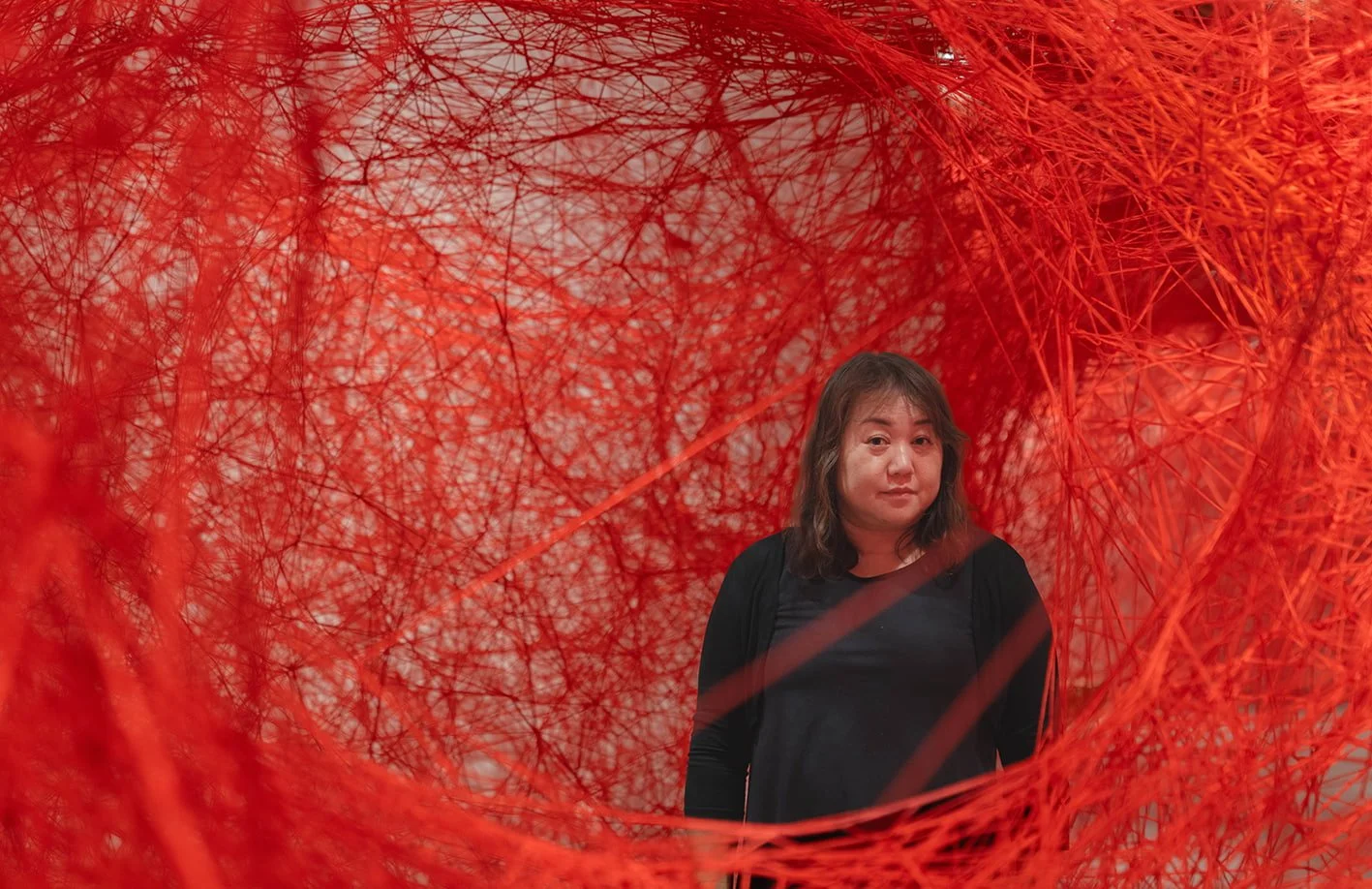
Read MoreIstanbul Modern is currently hosting the exhibition "Between Worlds" (since Septembre, 6th), featuring a large-scale installation created specifically for the museum by Japanese artist Chiharu Shiota. Shiota is well-known for her installations that primarily use thread as the main material. Shiota recently answered questions about the exhibition and her artistic practice.
Read MoreKurator Markus Heinzelmann hat die chronologisch gehängte Ausstellung „Verborgene Schätze“ genannt. Die Stücke stammen aus privaten Sammlungen rheinischer Kunstfreunde und von Unternehmen. Die meisten wollen anonym bleiben. Manche geben sich jedoch zu erkennen, der Fotokünstler Andreas Gursky etwa. Ihm gehört die „Weinernte“ von 1968, und darauf angesprochen, sagt er, Gerhard Richter sei für ihn eine „maßgebliche Inspiration“. Gerade die frühen Foto-Übermalungen hätten enormen Einfluss auf seine eigene künstlerische Entwicklung gehabt. Die meisten Bilder der Schau wurden selten, manche noch nie öffentlich gezeigt. Und natürlich stellt man sich vor, in welcher Umgebung sie wohl sonst hängen: Wohn- oder Esszimmer? Und wie ist es, unter einem Richter zu frühstücken? Manchmal lassen die Rahmen etwas von den Vorlieben der Besitzer erahnen.
Read MoreDressed in a chador and holding the barrel of a gun in front of her face, a woman looks at us. It is defiant, determined, militant, courageous. The title of the work, "rebellious silence", evokes her quiet sense of power. Her steadfast gaze suggests conviction and trust. On its face, in handwritten Farsi, is a poem that focuses on feminism about the law enacted during the 1979 Iranian revolution that still today requires all Iranian women to wear veils in public. . "The written text is the voice of the photograph", said artist Shirin Neshat. "This breaks the silence of the quiet woman." [...] While Neshat's series is rooted in the women associated with the 1979 revolution, their gaze evokes the determination of today's female protesters. The fact that the work has been banned by Iran highlights the country's conservatism.
Read MoreBy entering the show, one steps through Yoko Ono's gaze into a memory bank that includes seven-decades of her work [...] This reiterates Ono's premise : that the real aesthetic accomplishment exists primarily in one's own mind, or the mind of the viewer, even if that realization is catalyzed by material iterations-like a film, photograph, or performance.
Read MoreRosemarie Trockel explores the fascinating intersections of technology, memory, and artistic intervention in her limited-edition prints for Parley for the Oceans. This new series, launching in collaboration with Cahiers d’Art, a French-based publishing house and gallery, timed to Art Basel Paris in October, showcases Trockel’s foray into her photographic archive, where she employs AI to generate three compelling new photographic portraits derived from her personal images. Each AI-generated portrait is screen-printed on Trockel’s drawings, complemented by the artist’s signature spray-painted motifs. These abstract elements disrupt and enhance the compositions, adding depth and intrigue.
Read MoreYoko Ono is making a return to Baltic; not in person, as in 2008 when her work was the subject of a major exhibition at the Gateshead centre for contemporary art, but as an artistic presence. Her IMAGINE PEACE artwork, exhibited as part of that show, is being displayed again as a banner on the outside of the building to mark International Day of Peace on Saturday, September 21. With so much conflict dominating headlines, it can do no harm – whatever cynics might say - to pay heed to Yoko’s plea to “think peace, spread peace and act peace”. Baltic is marking the day with activities aimed at encouraging reflection on peace and unity. Visitors will be invited to add messages to a trio of Yoko-inspired Peace Trees and participate in creative writing workshops.
Read MoreKunsthistoriker Uwe M. Schneede über den künstlerischen Eigensinn und das Erfolgsgeheimnis des Malers Gerhard Richter. "Es gibt sehr viele Veröffentlichungen über Gerhard Richter, häufig sind das Ausstellungskataloge und Publikationen zu einzelnen Werkaspekten. Ich habe mich mit meiner Monographie an eine übersichtliche, kompakte Darstellung des malerischen Gesamtwerks gemacht. Ich versuche, zu seinen komplexen und komplizierten großen Abstrakten hinzuführen und zu erläutern, warum sich Gerhard Richter nie auf einen Stil hat festlegen lassen wollen, sondern immer gleichzeitig in den verschiedenen Modi, figürlich und abstrakt, gearbeitet und sie gleichwertig behandelt hat."
Read More"Gerhard Richter: Verborgene Schätze", Kunstpalast Düsseldorf, bis 2. Februar 2025. Die chronologische Hängung lässt den Wechsel der Stile und Experimente bis 2017 nachvollziehen, dem Jahr, in dem sich Richter offiziell von der Malerei verabschiedet hatte (inzwischen ist er vom Rücktritt schon wieder teilweise zurückgetreten). Darunter findet man Landschaften, Tierporträts, Abstraktionen und auch die späten Farbverschlierungen des Malers, der sich im Laufe der Zeit offenbar alle Freiheiten nahm, die ihm die autoritäre DDR nie zugestanden hätte.
Read MoreSharjah Art Foundation (SAF) is delighted to present "A Shadow of a Shadow" from 28 September to 8 December 2024, a comprehensive survey of 17 performances by William Kentridge spanning from the late 1980s to the present. Kentridge’s first major solo exhibition in the Middle East showcases a wide range of his work, from his interpretations of King Ubu—the outrageous protagonist from Alfred Jarry’s play Ubu Roi [King Ubu] (1896)—to Mozart’s opera The Magic Flute (1791) alongside Kentridge’s original production The Head and the Load (2018) about Africa and Africans during World War I. Visitors will encounter a variety of objects and artworks produced for the development and presentation of Kentridge’s performance projects, including drawings, stage backdrops, animations, puppets, props, costumes and installations inspired by theatrical illusions.
Read MoreIn the spring of 1961, Gerhard Richter, a young East German artist noted mainly for his portraits and socialist wall paintings, slipped through the last chink in the Iron Curtain—West Berlin—and fled to the Federal Republic of Germany. A few weeks later, he justified this move in a letter to his former teacher at the Dresden Academy of Fine Arts: “My reasons are mainly professional. The whole cultural ‘climate’ of the West can offer me more, in that it corresponds better and more coherently with my way of being and working than that of the East.” [...] This development can now be witnessed in a new exhibition ‘Gerhard Richter: Hidden Gems’, at the Kunstpalast Düsseldorf until 2nd February 2025. Dedicated to Richter’s relationship with his new home and, crucially, its affluent community of gallerists and collectors, it is aptly titled Verborgene Schätze (Hidden Gems). What makes it special is the fact that the works shown are, without exception, from private and corporate collections of the region. Many have never been seen in public before. [...] The 120 artworks shown encompass Richter’s whole production.
Read More