NEWS FEED


NEWS ARCHIVE

 
Sortir à Paris : The Soul Trembles: Chiharu Shiota's reopening exhibition at the Grand Palais (by Graziella)

The Grand Palais reopens its doors after years of renovation with an exhibition, and not just any exhibition, ascontemporary art lovers eagerlyawait the return of this artist to Paris, Chiharu Shiota! The Japanese artist with the red thread returns from December 11, 2024 to March 19, 2025, to weave her web under the capital's most famous glass roof with her unique and poetic installation. Following on from"Memory Under The Skin" at Galerie Templon Grenier Saint-Lazare,"The Soul Trembles" explores the vulnerability of life through a monographic exhibition co-organized with Tokyo's Mori Art Museum, the most important on the artist. The Grand Palais, in a preview to the reopening of its galleries in June 2025, is hosting seven monumental installations, sculptures, photographs, drawings, performance videos and archival documents relating to his staging project and his 20-year career.

Read More
gabriela ancoChiharu Shiota
Clash : Yoko Ono: Music Of The Mind

Yoko Ono has lived a life without boundaries. A Japanese woman who made her voice heard around the globe, she refused to let the barriers of race, class, or gender impede her message. A true cross-disciplinary artist, she has transformed her life into a near century-long creative practise. A ground-breaking visual artist. A profoundly influential musician. A peace activist across multiple decades. Yoko Ono is a by-word in freedom. Walking around London’s incredible new career-spanning exhibition Yoko Ono: Music Of The Mind at the Tate Modern, you’re struck by the sheer wonder, and the undaunted veracity by which she approaches art. A stunning display of virtuoso innovation, the awesome range of her creative force is enhanced by her unique ability never to repeat herself.

Read More
gabriela ancoYoko Ono
E-flux : Oum Jeongsoon, Ding Yi, Shiota Chiharu I Thought I Lost It!

I Thought I Lost It! is a project in the form of forum and exhibition that examines how art and architecture can contribute to the social consensus to create the resilient social communities we envision. [...] The invited artists for this project are Oum Jeongsoon from Korea, Ding Yi from China, and Shiota Chiharu from Japan. These artists share a common theme of challenging and exploring the implicit yet inescapable self-identity that humans experience as fate. Their works focus on how art should engage with, mediate, and respond to social change as well as inclusiveness. Additionally, the project investigates how contemporary, motivated, and democratized audiences should reassess art, urban spaces, and architecture. The participating artists also diagnose and validate the human absence and ecological crises subtly imposed by social systems driven by rapid technological advancements.

Read More
Luxuo : Underground Creatives Driving Social Change (by Natalie Chan)

Shirin Neshat, an Iranian-American filmmaker, is known for her politically charged work that delves into the intricate issues of gender and cultural identity in the Middle East. Her acclaimed film Women Without Men tells the story of four women in 1950s Iran, against the backdrop of the 1953 coup that toppled the democratically elected government. Through its poetic imagery and layered narrative, the film offers a nuanced critique of the patriarchal and authoritarian forces that shape the lives of women in the region.

Read More
Artdog Istanbul : Chiharu Shiota: Between Worlds

Collecting ordinary objects such as shoes, keys, beds, chairs and dresses and wrapping them in giant structures made of thread, Japanese artist Chiharu Shiota redefines the concepts of memory and consciousness. Her exhibition titled “Chiharu Shiota: Between Worlds” will meet with the audience at Istanbul Modern starting from September 6 to April 20, 2025. The exhibition, which also includes a large-scale installation created specifically for Istanbul Modern by Chiharu Shiota as part of the 100th anniversary of the establishment of diplomatic relations between Japan and Turkey, focuses on topics such as memory, existence, migration, journey and human experience, which the artist frequently uses in various forms of expression such as performance, video, installation and painting

Read More
Global Action for a World Without Nuclear Weapons Marks 79 Years Since Hiroshima and Nagasaki Bombings

People around the world–from artists and cultural icons like Yoko Ono and Paris Jackson to Nobel laureates, members of Congress, and global leaders and organizations–are marking 79 years since the Hiroshima and Nagasaki atomic bombings by taking part in #CranesforOurFuture, the largest digital demonstration of support for a world without nuclear weapons. To participate in the campaign between August 6 and 9, the dates of the 1945 atomic bombings of Japan, people fold and share paper cranes on social media with a message about why moving closer to a world without nuclear weapons is important to them.

Read More
gabriela ancoYoko Ono
New City Art : Weight of Lightness: A Review of Shilpa Gupta at Madison Museum of Contemporary Art (by Mána Taylor)

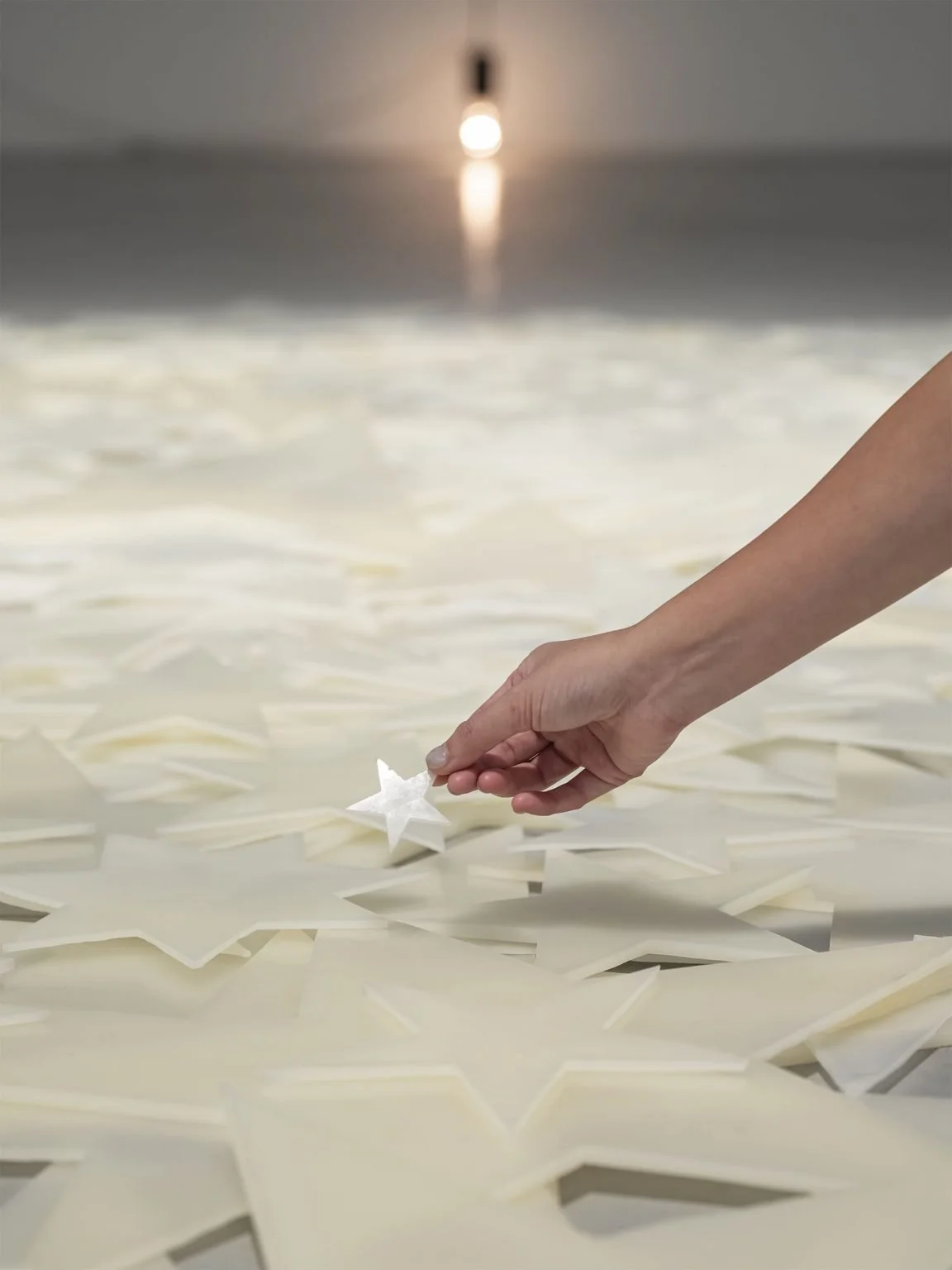
“Shilpa Gupta: I did not tell you what I saw, but only what I dreamt” is on view at Madison Museum of Contemporary Art through January 14, 2025. Gupta’s work takes all that we know about identity and breaks it apart, dispersing the elements until they’re abstract. In other works, she takes apart elements that represent countries, such as all the stars featured in various flags. They are relinquished to the floor, where visitors can pick up a wax star and take it home with them. I was reminded of Sylvia Plath’s poem “Candles,” when I picked up a star among other stars, and felt the wax in my hands [...] The exhibition is also a way to honor those who succumbed to censorship and a memorialization of all the important writers and artists who aren’t able to show their work freely. We take their names home with us, and remember them.

Read More
Goethe Institut : Ausstellung Rosemarie Trockel

Rosemarie Trockel ist eine der bekanntesten deutschen Künstlerinnen der Gegenwart, die auch international Anerkennung gefunden hat. Ein zentrales Thema ihrer Arbeit ist die kritische Auseinandersetzung mit weiblichen Lebenserfahrungen und der Frage der Geschlechterdifferenz. Rosemarie Trockel begann in den 1980er Jahren als Künstlerin zu arbeiten und machte es sich zur Aufgabe, die weitgehend männlich geprägte Kunstszene zu hinterfragen und dem männlichen Künstlergenie weibliche Rollen und Themen gegenüberzustellen. [...] Die monografische Ausstellung „Rosemarie Trockel – Ausgewählte Zeichnungen, Objekte und Videos“ (vom 29. August bis zum 27. Oktober im Sungkok Art Museum in Seoul zu sehen), zeigt die vielfältigen Arbeitsweisen der Künstlerin. Ein weiterer Schwerpunkt liegt auf dem Entstehungsprozess ihrer Werke. So wird jede Arbeitsphase in Tusche-, Kohle-, Bleistift-, Collage- oder Computerzeichnungen dokumentiert.

Read More
E-flux Announcements : Landscapes of an Ongoing Past Urbane Künste Ruhr

The exhibition "Landscapes of an Ongoing Past" (Salt Warehouse, August 16–September 22, 2024) establishes a dialogue between a major work by Ilya and Emilia Kabakov and a younger generation of artists from former socialist Eastern Europe on the premises of Zollverein UNESCO World Heritage Site. Since 2001, The Palace of Projects by the Kabakovs has been installed in the Salzlager (salt warehouse) of the preserved coking plant and industrial processing complex, an impressive site of cultural heritage located in Essen, North Rhine-Westphalia. The two-story, snail shell-like artwork, made of simple wood and linen, holds 61 proposals for a better future and is one of the Kabakovs’ largest permanent installations. In loose correspondence with it, existing as well as newly commissioned artworks by 17 artists explore traces of unrealized utopias, focus on questions of artisanal and industrial production, or reflect on the relationship between architecture and nature.

Read More
The Free Press Journal : Silent Voice Of Dissent: Arts Role In Challenging Authority From Goya To Gupta (by Sonal Motla)

Standing before his unflattering portraits of Spanish royalty, I was struck by how Goya’s art transcended traditional representation to challenge authority and reveal deeper truths. [...] His portrayal exposes the vanity and moral decay of the royals, turning a conventional portrait into a powerful critique. This act of artistic rebellion was a courageous statement, urging viewers to confront uncomfortable truths about their leaders and the nature of power. [...] This courage to confront authority is mirrored in Shilpa Gupta’s recent installation, “Sound On: Untitled, 2023.” Exhibited at Amant Art Center as part of "I Did Not Tell You What I Saw, But Only What I Dreamt," Gupta’s kinetic installation uses reverse-wired microphones to create an immersive auditory experience. The installation features a rotating voice reciting the names and detention dates of poets who have faced imprisonment, exile, or execution, including the grim fate of fourth-century poet Imadaddin Nasimi. A solitary lightbulb and evocative soundscape underscore the humility and resilience of these censored voices.

Read More
Observer : Rich Tapestries and Loose Ends: ‘Woven Histories’ Is Unwieldy in Its Comprehensiveness (by Katherine Schreiber)

This year seems to be, among other things, the year of the textile. The past six months have seen a plethora of fiber-centered shows at major museums, from “Weaving Abstraction in Ancient and Modern Art” at the Metropolitan Museum of Art to an exhibition of women fiber artists at the Smithsonian American Art Museum. [...] But the most comprehensive—and often unwieldy—of these shows is “Woven Histories: Textiles and Modern Abstraction,” a traveling exhibition that just closed at the National Gallery of Art in Washington, D.C. and is on its way to the National Gallery of Canada, after which it will be shown at the Museum of Modern Art. The show, which originated at the Los Angeles County Museum of Art last fall, aims to recenter fiber art in the story of modernism—to reweave textiles, so to speak, into the fabric of art history. Its central claim is that “abstraction, modernism’s primary visual language, has been entwined with textile materials, technologies, and issues since its inception.” [including works of Rosemarie Trockel].

Read More